


Well, perhaps not everyone loves an origin story.
My wife, who admittedly can be quite snobbish when it comes to movies and TV shows, has been one to repeatedly roll her eyes at yet another entry in the Marvel Cinematic Universe (MCU), which must spend the first act or more creating a dramatic origin for our beloved protagonist before getting to the real action. If you are familiar with these movies, you are likely familiar with this concept. Usually, the protagonist suffers a traumatic experience in which they are likely powerless to prevent; a family member dies or vanishes, they suffer a life-altering or even life-ending injury, they are juxtaposed into a vastly foreign environment, or they become so figuratively absorbed in their exotic science experiment they eventually become…physically absorbed. Maybe keep your fingers crossed in an attempt to prevent that last example from happening to you by the time you reach the end of this book.
So, if not everyone loves an origin story, why do we have so many?
I am so glad you asked. Well, at least I am glad that I wrote the question, you read it, and therefore I forced you to ask. I never promised voluntariness in inquiry.
In a 2011 study, Gazley and colleagues found among a group of 225 New Zealanders that genre had a significant effect on a potential moviegoer’s decision process, specifically for comedies, dramas, and horrors. They also found that respondents view movies depicting true stories more favorably compared to movies derived from fiction or folk stories. Now, while this does seem counterintuitive to our discussion on the action-based, science-fiction movies of the MCU, they also note that it is likely the relatability factor that creates this favorability.
So, perhaps the creation of origin stories for our Marvel superheroes is an attempt to foster that relatability. Spider-man (2002) featured a lanky, nerdy Peter Parker, played by Tobey Maguire, who was bullied, in unrequited love, and struggled with wanting to be better than he was. That seems relatable enough, right? According to a 2002 article in the Hattiesburg American, that movie grossed $114 million in the opening weekend at the box office, the first time any movie had grossed over $100 million in only three days. Is it because people loved the origin story? Or is it just because, well, it’s Spider-man?
Okay, technically, it took nearly two decades for Tobey Maguire’s Spider-man to somewhat become part of the MCU. Let’s look, instead, at Iron Man (2008). Gray (2010) reported that this first entry into the MCU grossed $98.6 million in opening weekend, and McMahon (2025) reported that the film grossed over $585 million worldwide against a production budget of $140 million. In comparison, Gray (2010) also reported that Iron Man 2 (2010) grossed $121.8 million during opening weekend. Hmm…
Let’s go back to the character of Spider-Man, since, within a few short decades, we have seen a few iterations of the character with different origin stories, and this is just in the films.
Figure 1. Ranking of Highest-Grossing Spider-Man Movies Worldwide as of November 2024, by Box Office Revenue (in million U.S. dollars)
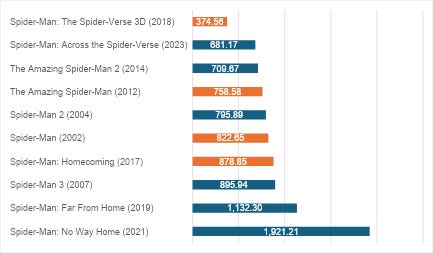
Note. Adapted from “Ranking of highest-grossing Spider-Man movies worldwide as of November 2024, by box office revenue (in million U.S. dollars)”, by Statista Research Department, Statista, 2025. Copyright 2026 by Statista.
In Figure 1, we can see all the Spider-Man movies from 2002 to 2024 ranked by box office revenue. The origin stories are highlighted a different color, just to help with this discussion.
The question remains, does everyone really love an origin story?
With the exception of Tobey Maguire’s and Andrew Garfield’s second movies, we know that the sequels, for the most part, performed better than the origin stories in overall box office revenue. So, does that mean moviegoers prefer sequels to origin stories? Are these numbers simply indicative of the years of inflation between origin stories and sequels? Would the sequel have even performed so well in the absence of an origin story?
I know what you are thinking. What does all this mean?
Absolutely nothing.
I just provided a bunch of data. Box office revenue is one of the most important lagging metrics to determine a given movie’s performance. Movie-making is a business, after all, and with all this data, we should be able to determine the popularity of origin stories.
But we can’t.
We have data, and it’s data that everyone uses as a primary metric, but we do not have the right data to answer the primary question. In fact, we have more questions. To answer those questions, we can make assumptions. We could say that people love origin stories, but perhaps they love sequels more. Is that true? If this is all the knowledge you had to assess the likelihood of popularity for a movie you were about to create, would you go with the origin story, or dive right into a new story based on the assumption that everyone is already familiar with your main character from the comic books? If millions of dollars are on the line, do you take the gamble?
Does everyone really love an origin story?
Honestly, I don’t know, and I couldn’t care less. Here’s mine.
How a bright-eyed, young safety professional became a seasoned yet cynical researcher with a podcast who, for some reason, still gets asked if this is his first job out of college…
I have always been one to challenge the status quo. Sometimes, like when I was a young, hot-headed, egotistical undergraduate student, that notion tended to result in bridges burned and diminished grade point averages. It took arguably far too many of those hard lessons learned to eventually turn my boldness, and sometimes my undue pride, into a strategic advantage. Eventually, some things worked out.
Almost every emerging safety professional gets the privilege of experiencing a root cause investigation fairly early in their careers. If you happen to be unfamiliar with this process, this serves as one of the first shocks to a safety professional’s system, when they realize that real-world applications of safety practice do not always end with butterflies and rainbows. Something goes wrong, people get hurt, equipment gets damaged, and yes, the safety professional must figure out what exactly went wrong and how it can be prevented in the future.
In my case, I directly reported to who I consider to be the classical type of operations leaders, those who did not have the time nor the skillset to look much further past the human behavior that they believed caused the incident to occur. They would blame the incident on the worker, or sometimes the supervisor, and call for more training. Check that box, and move on.
However, as a foundationally public health professional with experience and academic training in human behavior models, I was the one who wanted to dig deeper. What was the experience of the worker that influenced that behavior? What was the historical context? What were the traditions of work that have been passed from generation to generation, becoming the things that we knew so well, took for granted, and never had a clue they could lead to adverse outcomes?
One of my proudest moments was when I was able to put this into action. A construction worker under my purview had unfortunately dislocated his ring and pinky fingers while changing a bit, specifically a hole saw, in a portable power drill. How did this happen? By doing what had always been done. He grabbed the chuck of the drill with his gloved hand and squeezed the trigger with his other hand to use the power of the drill to loosen the chuck, the glove became caught on the teeth of the hole saw, and the pulling force caused the dislocation.
Now, the operator’s manual for that power drill says to remove the battery before changing bits. So, why was that practice not performed?
Because that’s not how it’s done. That’s not how this worker was taught to do it, and that’s not how any of the hundreds of his peers on that same site do it. Using the power of the drill to loosen and tighten the chuck is a tradition that has existed for decades.
So, mister operations leader, go ahead and check your behavior box and blame this guy for doing something stupid, but prove to me that doing so actually fixes a deeply rooted human habit that has become a normative practice for generations of workers performing the same task.
I loved playing devil’s advocate because I wanted people to prove to me that their belief was correct. I needed data. I needed operations leaders to follow proven models rather than haphazardly tossing blame around. I needed conference presenters to give me evidence for their big ideas rather than just empty inspiration.
This probably explains my attraction to research which really came to fruition during my doctoral studies. I discovered that the scientific method used to dig deeper into problems and solutions was not really that complicated. In fact, just because I now have a degree that proves I can do it does not mean that I could not have done it all along.
I just needed methodology.
Honestly, that methodology is what everyone needs, all the way down to the practitioner. The daily grinder. The folks who are actually positioned to save lives.
The problem is, when that methodology is practically implemented, especially in work like mine, it is often presented either overly complicated in academic literature or overly simplified in news headlines. Neither one is practical for the practitioner. That practitioner may fall into the common trap of the big sexy ideas presented at conferences, those big ideas that most often come in 45-minute conference presentations with little practicability. There are no action items. There are no applicable metrics. It’s just fun noise.
So, I thought, now that I understand research, but not every practitioner is going to go through the torture of completing a doctorate, how could I help get real science into the hands of the practitioner? How could I help the practitioner learn simple scientific methodology to determine if a study, or a big idea, is good or bad?
I really needed a source for catharsis. I have always wanted a creative outlet. I suck at drawing. I’m okay at music, but I never had the drive to make that a thing outside of my college worship band and a handful of weddings and bar gigs. How could I be creative, but maybe also turn that into something that gives back to my profession in occupational safety and health?
And so, with a desire to get science into the hands of the practitioner, and a passion for creativity, along with a tiny bit of entrepreneurial spirit, I decided to make a podcast, called Prove It To Me, which, to date, generates absolutely no revenue but hopefully creates value for the listeners. The goal has always been to evaluate researched solutions, good or bad, and get that evaluation, along with actionable takeaways, into a digestible format for practitioners.
Then I thought, maybe practitioners don’t just need examples of research. Maybe they need the ability to do research themselves. With the variety of industries, organizations, workers, processes, policies, and situations that exist, there are so many possible solutions to key occupational safety and health issues that have never been studied and may never gain the opportunity to be studied through traditional means. What if practitioners could be empowered to scientifically evaluate these things themselves?
Well, they could go to back to school to be scientists. Or…
…they could acknowledge that they are already scientists. In that case, they just need the tools.
Thus, here we are. I wrote a book. You’re reading the book. Here are your tools.
You’re welcome.
Did everyone love this origin story?
This is what this book is about. We have traditional ways of measuring safety performance. For the most part, those traditional ways are not working. Each organization, each safety practitioner, must be able to measure the things that matter. They must be able to measure the things that they have traditionally considered unmeasurable because no one gave them the tools to be able to do so. They must be able to navigate through those big sexy conference ideas and prove to leadership whether they work or don’t work. They must be able to implement the scientific method.
So, let’s get to it, shall we?
References
Gannett News Service. (2002). ‘Spider-Man’ spins magical web on weekend moviegoers. Hattiesburg American. https://www.newspapers.com/article/hattiesburg-american-spider-man-spins/102160352/
Gazley, A., Clark, G., & Sinha, A. (2011). Understanding preferences for motion pictures. Journal of Business Research, 64(8), 854–861. https://doi.org/10.1016/j.jbusres.2010.09.012
Gray, B. (2010). Weekend report: ‘Iron Man 2’ builds on ‘Iron Man’ launch. Box Office Mojo. https://www.boxofficemojo.com/article/ed695862276/
McMahon, K. (2025). Iron Man (2008) - The ultimate guide to the birth of the Marvel Cinematic Universe. Pop Culture Weekly. https://podcast.popcultureweekly.com/blog/iron-man-2008-the-ultimate-guide/
Statista Research Department. (2025). Ranking of highest-grossing Spider-Man movies worldwide as of November 2024, by box office revenue (in million U.S. dollars). Statista. https://www.statista.com/statistics/1388739/highest-grossing-spider-man-movie-worldwide-box-office/